
June 10, 2019
The JKD Parry Scientific Defense at its Best
Many times, a student starts learning about the efficacy of the leading straight punch in JKD but runs into a serious problem. What’s the problem? Well, to put it bluntly – they get walloped by a shot as they’re throwing their vaunted punch, or directly after they throw it. Naturally, no one likes getting punched in the face. That’s less fun than paying taxes. But it also causes many people to spurn JKD altogether. They figure it doesn’t work. They threw the famous straight punch and got hammered for it. That’s it.
Or, instead of quitting JKD altogether, some people add a gazillion other things to it, making it all but indistinguishable from the methods they added.
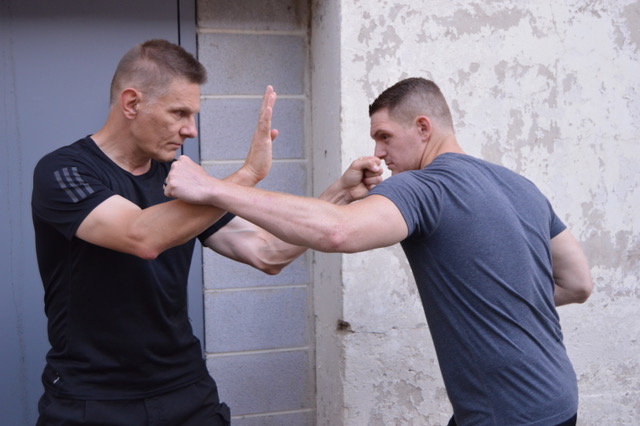
Well, you can avoid this problem by understanding and properly training JKD’s helping hands – that is, the parry. As far as defense goes, footwork is the king. Nothing is better than simply not being there. After all, no tough guy can do the physically impossible: he can’t hit what isn’t there. But as important as footwork is, no matter how good you are, there are instances when you need a little extra help. And that’s exactly what the parry gives you.
Of course, the stop-hit is the key to the whole shebang. Everything in JKD is a set-up for it. And the straight hit from the forward (preferably power) side is integral to the counter-attack. But you can’t just stand there and throw your shots. That’s called over-simplification and results in the aforementioned wallop you receive from mindlessly throwing the stop-hit because, hey, it’s the backbone of JKD. Yes, it is, but the backbone, last time I checked, isn’t the only part of the body. Footwork and timing are critical too. And so is the parry.
The parry is important to JKD because it’s a precision move, not like a block. It’s a quick deflection against a weapon that beat your stop-hit and footwork, which doesn’t require a disruption of your balance. This is critical because it allows you to instantly counter with one of those rapier-like straight hits. A block is a blast of power on power and shouldn’t ever be confused with a parry. In fact, a block is to a parry what a man screaming is to a great vocalist.
Watch Bruce Lee use the parry in the Chuck Norris fight in Way of the Dragon and notice how he’s able to move, parry and counter. It’s all integrated. If you abandon one element of this tactical/technical mix, you invariably kick the others to the curb too. Imagine Mike Tyson without the quick head-movement. You can’t. The peek-a-boo style of Tyson is built around it just like Lee’s JKD is built around the long, straight counter-hits from the leading side.
Some critics have opined that most people can’t do JKD because they aren’t as fast as Bruce was. They say, “he was fast enough to stop-hit…you’re too slow so you’ll have to do something else…something more complicated…and, quick, buy my new video series on how complexity is the new simplicity.” But this is a false dilemma built around the mistaken notion that the stop-hit is supposed to work every single time. That would be nice but it’s unlikely, which is why we have the footwork, head-movement and the parry too.
So, if you aren’t as fast as Bruce don’t worry about it. You can still do JKD – you just probably need to parry and move more than he did. You don’t – repeat don’t – solve a speed deficit by doing more complicated stuff. That’s like not having money so you borrow more – it only increases the problem (unless you’re the government…governments are immune to the laws of basic economics).
Think of the rear-hand as the goalie and defense on your soccer team. If your goalie is really good, the other team is going to have a rough time beating you and that’s the whole point. This is a critical thing to understand: in JKD, the back hand’s primary responsibility is to play goalie, not try and score. It can get in on the offensive action but most often only when it comes in as a coup-de-grace. Jim Driscoll wrote at length about this use of the rear-hand in his small but masterful book The Straight Left and How to Cultivate It. That book, you should know, was a huge influence on Lee and JKD. Driscoll reasons that it’s a grave mistake to throw the rear-hand into the offense until there was a clear opening. He likens it to fencing but acknowledges, of course, that the rear-hand must be used in fighting. Nevertheless, the whole structure of JKD is set up to “keep the line” – that is, keep the front (power-side) weaponry between you and the opponent. They (the lead hand and foot) do most of the hitting, which gives you distinct advantages both offensively and defensively. On offense, you have greater range than if you’re squared up, and you’re more mobile too. On defense, critically, you’re a smaller target and that lightning-fast lead hand is ready to make a mess of the bad dude’s face.
The parry works when one of the enemy’s blows gets past your primary defenses – your lead punch/kick and footwork. Blocking or covering up breaks this tactical/technical structure and should, therefore, be abandoned unless absolutely necessary. Parrying works better than either of those two because it keeps the counter-attacking lead side in play. The rear-hand can guard either flank easily, using either pak-sao or tan/bui sao. To protect the lower gate, the rear hand can again execute a low pak or a guan. These movements are directly integrated from Lee’s Wing Chun training. They’re simply modified – just like the straight lead punch is – to work from slightly longer range.
Now, a goalie isn’t good if he’s wandering the field, trying to score and neither is your rear-hand much good if it’s too far forward when you’re at long range. Close range fighting, naturally, calls for a different approach. But at long-range, the lead-side weaponry needs support, that’s all. If you aren’t fast enough to score stop-hits, move and then counter. Or, more to our point, parry and counter. Don’t throw away your whole system because you aren’t as fast as Bruce, just understand that the system has back-up plans.
The lead-hand can be used to parry just like the rear-hand can (and should) be used in attack. The issue is one of generalship. The lead-hand is better deployed on attack and the rear (when at long-range) is best kept near the goal – which is your beautiful face! Understanding this will keep you from running into counter-shots and is a key point in properly understanding and, importantly, applying JKD under pressure.
Get My Free Pass
June 30, 2018
Soft Targets: The Achilles Heel of Sport Based Fighting Systems
It seems rude to point out, almost like bringing attention to the finely dressed woman at the party, replete with the best fashions, that she has something stuck between her teeth. But the vast majority of martial systems today are suffering from a glaring weakness. And, lest you think that by vast majority I am merely throwing words around, and the problem isn’t all that bad, be certain that 99 in 100 martial artists are suffering from this. And this may even be a generous, soft-peddling of the problem.
The problem, for the most part, is that martial arts have gone the way of martial sports. Some have eschewed the primacy of attacking and defending the body’s weakest areas for the idiotic sake of complexity too – they just think other stuff is more cool, which is like a man getting attacked in an alley by a gang and whipping out his trusty nunchucks instead of a Glock 9MM because the aforementioned rice-beaters are way cooler. Such is the insanity of a man throwing a reverse kick rather than an eye-jab.
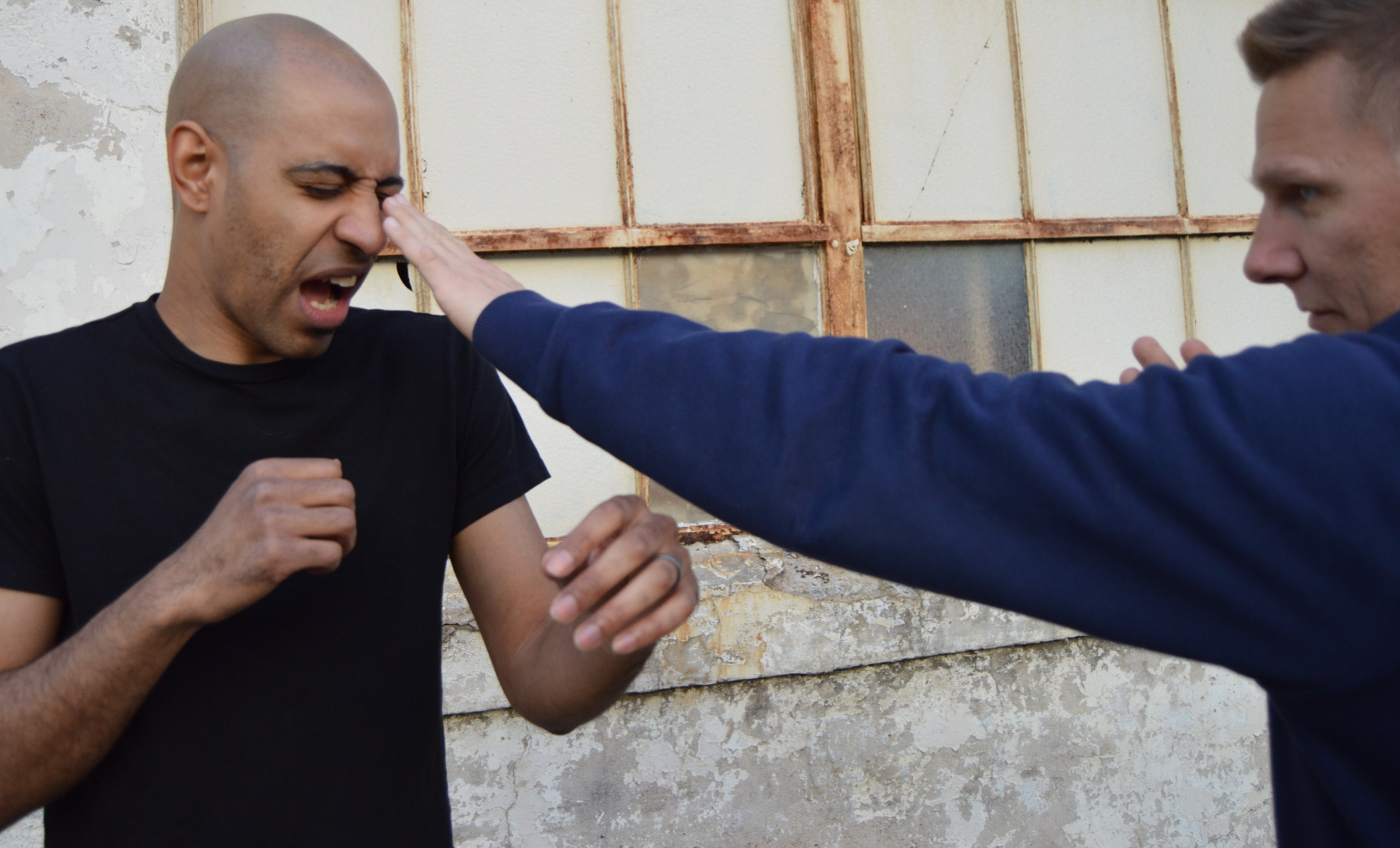
It’s these twin terrors that have utterly decimated modern martial arts from being what a martial art was and is meant to be: a fighting system, instead of a cool martial athletic club. And that’s exactly what most schools are because they’re focusing on things that aren’t essential to all-out fighting. What is? Well, for goodness sake, it’s scientifically attacking and defending the softies – the eyes, throat, groin, shins and knees.
Now listen, I’m sure this is going to offend many out there because we all have our favorites, but this isn’t about a match in a ring or a cage or even a sparring match at the school on any given Wednesday night. This is about survival, pure and simple. If two thugs attack you, helter-skelter ambush style, throwing haymakers and looking to do serious damage and then stomp your head into the pavement after they knock you down, and you’re fighting with rules then you have a serious oversight impeding your success. And, remember, success and failure in this instance could very well mean life or death. So, I’m terribly sorry to have to throw some methods under the bus, but in the name of the truth and your safety, these things need to be considered.
The Attribute Paradox
A person’s physical size, strength, movement speed, timing, endurance, flexibility and pain tolerance all play huge roles in their success as a fighter. Don’t ever believe otherwise. As JKD students we should train intensely as if these were the only qualities determining whether or not we live or die while at the same time developing tactics and techniques that reduce our dependence on attributes as much as possible.
The reason for this seeming contradiction is simple: if we fight in such a way that requires us to be the better athlete in the fight and, for whatever reason we are not, then we have horrible problems. Conversely, if we ignore physical conditioning and tell ourselves that we’re going to just kick a dude in the nuts and be done with it, and we miss, or he eats the shot and keeps fighting, then we’ve created another grave conundrum for ourselves. Both are needed. The proof of this is in the body and work of Bruce Lee himself. He trained like a professional fighter, was a superlative athlete, and yet ruthlessly attacked the key areas of the enemy. JKD reconciles these two – attributes and real fighting tactics so as not to be overconfident and/or unprepared in either area. To my knowledge, no other fighting method does this quite so well, with so much logic.
For example, it can easily be argued that some of the finest conditioned athletes on the planet – some of the physically toughest – are modern MMA fighters. I can personally attest to their grit, determination and skill. Owning a martial arts school with MMA fighters in it, I routinely get a chance to see some of these fighters up close and personal and I marvel at their pursuit of excellence and devotion. Boxers and kickboxers too…they are outstanding athletic warriors and we should be encouraged by them – us martial artists – to train hard and be in the best condition we can.
But there have been many examples in the cage where one fighter “accidentally” pokes his opponent in the eye. (We must note that some fighters have this happen too many times for it not to be an intentional act on their part, but that is another story). Nevertheless, whenever a wayward finger jabs an eye there is always a terrific response. The recipient howls in pain, covers his eye with his hands and hops around like a toddler in pain. Yes! A great and world-class fighter reduced to this by a finger in the eye. Naturally, this causes a break in the action too – giving the stricken fighter a chance to recover himself. This same scene happened as long ago as the first Ali-Frazier fight in March of 1971 when the ref accidentally poked Frazier in the eye as he endeavored to break up a clinch. Frazier, who had taken hundreds of sharp blows to the head from Ali all night, unfazed, was quickly hopping and howling after the middle-aged refs finger caught him.
The same happens when low blows land in both MMA and boxing matches as well. You see, no matter how well conditioned these fighters are, there is literally no way to toughen one’s eyes or village people. There just isn’t. It’s not possible. You can marvel at a Muay Thai fighter kicking a tree with his shin bone all you want but know this: his guys are open before and after every kick. Bruce Lee saw this and we should too. And this is precisely why there are no Muay Thai round kicks dominating real JKD practice. Again, it goes back to trading in your handgun for an Okinawan farm tool. Why waste all that time getting good at something not as effective? It makes no sense unless you’re ego driven and want to wow people with all that power. Or, you just love throwing the round kick like that, which is fine as long as you know that it isn’t the most practical means of defending yourself.
At this point there’s bound to be the dissenter that will bellow on about how some champion or another can round kick a house in half. Well, this very well might be true but the truly valid question as to self-defense is whether or not you can do that. In either event, maybe your Thai idol can truly kick that hard but one has to conclude that kicking a man in the groin is always better than kicking him so hard that you could knock his house down. All else being equal, no man’s thigh is less prepared for a strike than his fellas. Moreover, and this mustn’t be forgotten – in throwing the roundhouse kick we have to expose our own groin. But throwing a good groin kick yourself can keep you maximally covered.
Thus, it logically and ruthlessly targets the eyes, throat, groin, shins and knees, while using footwork and timing to protect their own targets. If the JKD fighter, properly trained, discovers during the encounter that they are indeed the better athlete, so much the easier for them, but they never assume such a thing. One groin strike can incapacitate a fellow, maybe even kill him. Most methods today don’t even bother defending this. It’s like the Death Star floating along with a big red-spot on its exterior, virtually undefended. Certainly, since its so wide-open and hardly defended, one doesn’t have to use the Force to attack it.
So, no, we’re not saying that a JKD student should avoid the vigorous work of training like a fighter. He should. We should strive to be in better shape than sport fighters, in fact. Our founder – that ridiculously ripped fellow in all the movies that inspired us – was. We should be like him and get in the best shape we can be in. But, also, we need to train like this while avoiding becoming a sport fighter. We’ll cover this more as we go and it has everything to do with the right attitude (starting here) and the ready position, footwork and weaponry integration that only JKD offers the modern warrior. This way, in the end, we can hang with the sport fighters in terms of conditioning, timing and emotional toughness, but we are eye-jabbing, groin kicking machines. Lee was a professional; his JKD followers of the current generation should be too. But he was a warrior, not a sport fighter and we must remember that as well or else JKD becomes diluted and unfit for the realities of real world violence – life and death, not victory or defeat; and not unanimous decision or split decision, but safety or morgue.