
June 19, 2026
Chi-Sao: The Key to Infighting Dominance
Imagine reporting for basic training in the Army or Marines. A bunch of stuff you’d rather expect. The electric hair-style options, the exotic array of fashion choices, the delectable culinary offerings, and, of course, those gracious hosts known as DI’s. But, seriously, what you wouldn’t expect, nor would any serviceable military ever do is send you off to a scrimmage. And by that we mean a live-fire competition.
As I write this, in fact, my son’s baseball team is gearing up for the start of its season by playing intra-squad scrimmages. MLB uses Spring Training much this way, and that’s what pre-season football is basically – actual games that don’t count. They’re for practice and the practice is as close to the real thing as you can get.
The military can’t do that, however, and for quite obvious reasons. We’re talking about the military here, so don’t think some jokers haven’t seriously contemplated this as a workable option for improving combat readiness. We know they have. They’re always looking at ways to maximize the performance of their troops. To that end, everything involved in military training is (at least on paper) supposed to serve the purpose of preparing soldiers for war. Marching, getting up at the crack of the crack of dawn, standing at attention…all of that isn’t about killing an enemy and breaking his toys, but does inculcate the habits of character and self-control that assist a solider in achieving those martial goals.
And let’s be blunt: the object of a military is to kill the enemy and destroy his physical capacity to wage war. In other words, kill and destroy. Wars are not won, nor peace kept, with good intentions for the simple reason that man has an aggression problem. See Cain and Abel. See the Song of Lamech. This is hard to understand for many people these days because their anthropology is upside down and backwards. They think as deeply about true human nature as my dog does about math.
So, if that’s the goal of a military, what’s with all the getting up early, marching, standing at attention, and all that jazz? How exactly does that achieve the death of the enemy and destruction of his stuff? Obviously, it inculcates certain character qualities, teamwork, and discipline under pressure. Add to that stuff drills with their weapons. Lots of drills. And you get the idea.
But an actual scrimmage?
That would be insane.
It’s for this reason that honest-to-goodness martial art training is more like military training than it is sport fighting. Military discipline intends to makes soldiers who can control themselves, follow orders/directives, know their weapons, and have seasoned “combative reflexes” through thousands of reps. This isn’t any different than a martial artist in principle. Military training, due to the vicissitudes of war, can’t become as hyper-focused on only one line of engagement as, say, a boxer. There are vast differences between fighting in an urban center against irregular forces, duking it out in the desert versus another mechanized army with close-air support, and jungle warfare.
That’s not much different than not knowing if you’ll have to engage an enemy (or enemies) in the entry way of your home, a parking lot, or a public restroom – just to name a few. For these reasons, much training goes into building up attributes of body and character as well as “reflexive principles.”
And this is where Chi-sao comes in.
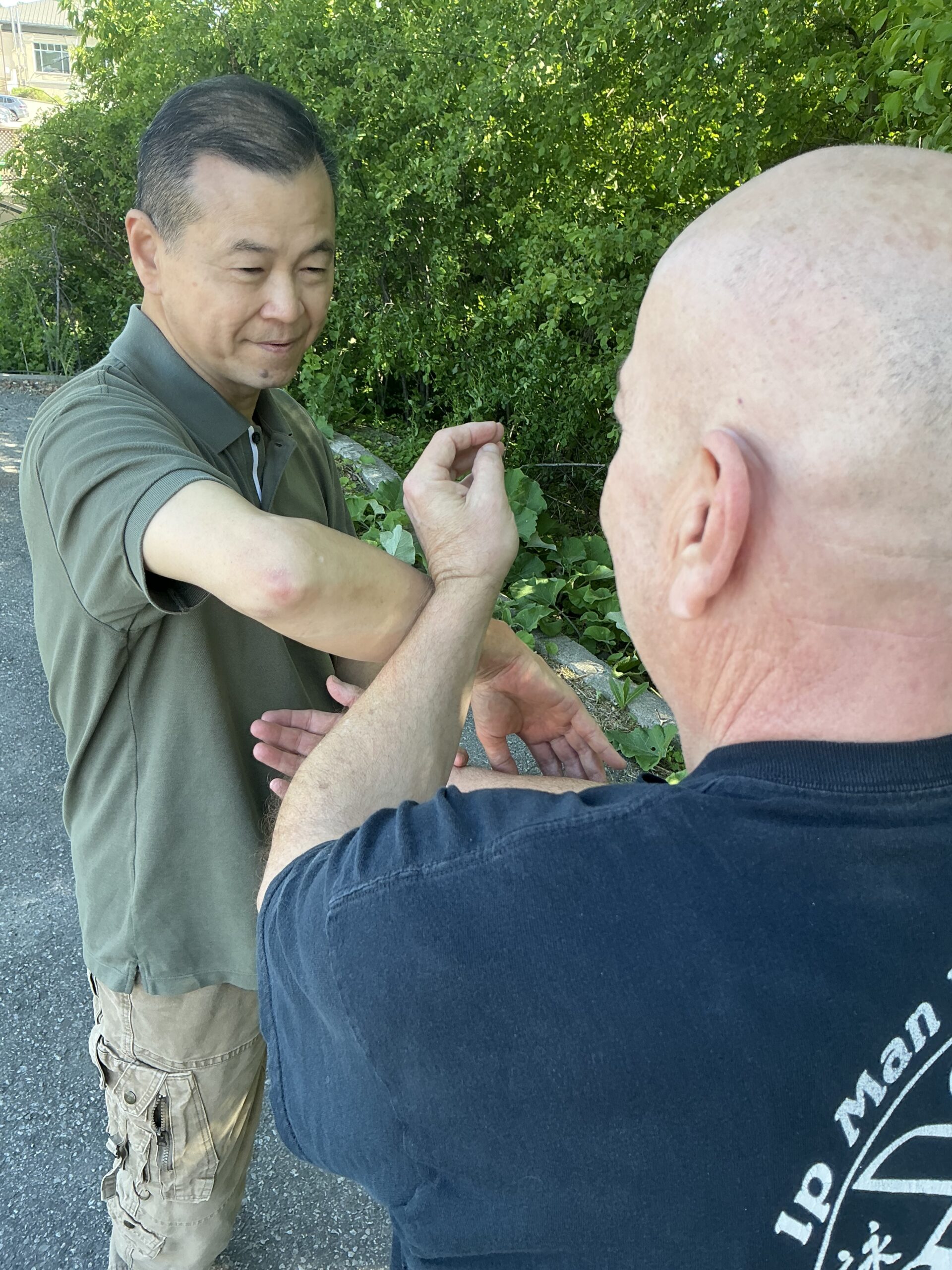
Chi-sao isn’t fighting. But it is a war-game. It’s about developing precision reflexes needed to be successful at close-range combat in that veritable no-man’s land between full-on striking and wrestling. Like a scrimmage in war, a live-fire drill where the participants exchange eye-gouges, elbows, hits to the neck, throat, and jaw, is as safe as driving with your eyes closed (though, in all honesty, that couldn’t impair the drivers more than they already are in Greenville).
Chi-sao is a war-game. It’s a pressure-test in which we take the structures developed in the empty hand forms and learn how they’re applied. It teaches and pressure tests. It’s a laboratory and classroom. It’s philosophical – a conceptual bridge between the purely theoretical and the potential of the application systematic taught as well as implied in the forms. It’s also stunningly practical – honing our skill to apply both the lat sau jik chung and lin siu daai da concepts of Wing Chun. We’re taught to attack aggressively when there’s an opening (the former) but to do so with defensive control (the latter concept). It’s in Chi-sao drilling that this is best experienced.
Without Chi-sao there really is no Wing Chun. How else can we drill the essential components of the system’s applications? How else can we bridge the gap between the theory of lat sau jik chung (when free of obstruction, attack instinctively) and its practice? How do we know for certain that our personal practice of lin siu daai da (simultaneous attack and defense) is skillful unless we practice it safely under pressure? Oh, and for the record, and for you Wing Chun nerds out there, we don’t believe that lat sau jik chung is an absolute combat principle. Control is. But that’s another article for another day.
Anyway.
Wing Chun’s major principles are all best experienced during Chi-sao. Centerline, facing, stealing/borrowing force, and structural power from the ground up, are all best – and safely – trained in the drill.
All-out fighting is far too dangerous to practice.
That shouldn’t be anything but obvious, but judging from the online geniuses and MMA-bros that abound these days, who think hard sparring isn’t just the thing, but the only thing, it needs to be stated. And boldly.
No training is the real thing or the totality of that thing. And that thing we’re speaking of is self-defense combat wherein we’re forced to defend ourselves.
All combat drills require conditions for safety. All training requires some concessions – even if we were to ignorantly say there are none and let students have at it. There are always fences around our disciplines because we, being human, live within a world of fences both moral and physical. This means our choices of training should be as logical as possible in order to produce the results we want while minimizing risks to health as much a possible.
Chi-sao does this. If we do it right. By that we mean understanding the amazing world of principled-pragmatism in which Chi-sao lives and breathes. In other words, we must have a safe but dynamic drill that assists us in developing non-contradictory skill for the purpose of all-out self-defense combat. In chi-sao we learn the most critical thing about this. What’s that exactly? We learn to systematically control the enemy, while simultaneously attacking his most vital targets. The eyes. The throat. The neck. His balance. Pushing, pulling, throwing, kicking, gouging, breaking. Yes. It’s all in there. When done and practiced correctly.
Mind and body. Both must be taught because all practice is the practice of a theory. Gordon Clark, the philosopher/theologian said that practice without theory is blind (modern MMA, sport schools, or schools of “self-defense” that have no clear system), but just as well, theory without practice is dead.
Ip Man Wing Chun is a system of mind-body. It’s a frightful tool and yet an exquisite one too. A brilliant systematic that awes the mind and protects the body – from others and self! It’s a thing of sweet paradoxes that develops amazing power and speed upon a foundation of relaxation and logical structure. It’s simple, yet comprehensive. And chi-sao is its heart and soul. Without it, or doing it wrong, our practice of Wing Chun is severely compromised if not eviscerated.
Can you systematically attack and defend the body’s weakest targets at close-range in any environment? Can you overcome height, speed, strength and reach disparities? Can you reflexively dominate an enemy up close by attacking targets that simply can’t be hardened or conditioned? No one can do this instinctively. That’s what a system is created to achieve. That system is Wing Chun and its genius is in chi-sao.