
September 23, 2026
Power & Distance Control in JKD
The push-shuffle lead punch is the cornerstone of Jeet Kune Do.
The reason why is simple: when mastered and expertly deployed it allows the JKD fighter to dominate distance and time. It’s more than just a mechanical thing. It’s a brilliant and brutal integration of fistic science and tactical genius.
When mastered it allows you to control the enemy via footwork and distance and, critically, punish them for not having good footwork themselves.
The brutal truth is that the majority of fighters have terrible footwork. They move or they hit and have no integrated system that combines striking and movement. For this reason they need an opponent who agrees to the distance by freezing in the pocket, charging forward themselves, or backing straight up. This is what we see most of the time. People moving or striking. Don’t be that guy!
JKD’s push-shuffle lead does both. It moves and strikes simultaneously. By doing so, it weaponizes distance control.

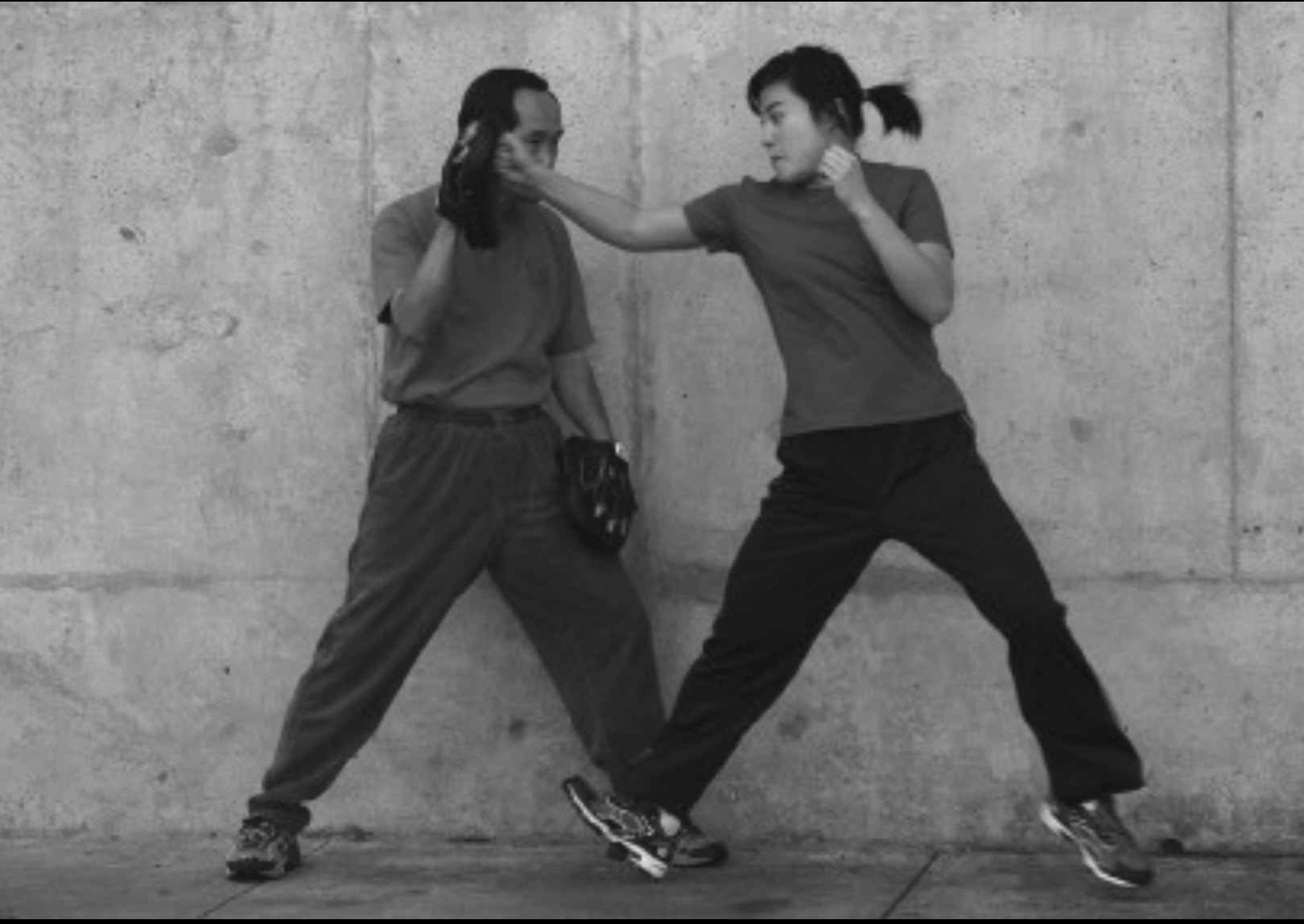
The push-shuffle lead is basically a leading straight punch thrown slightly ahead of the footwork and propelled by it. It’s a straight lead punch combined with push-shuffle footwork launched from the fighting measure. Most fighters are as ignorant of striking from the fighting measure as I am about women. The key is to remember that fighting is a game of accessing a target while not being one yourself. It’s simultaneous attack and defense via the integration of hitting and moving.
What Jeet Kune Do does is take this seriously. Very seriously.
And that’s your ace in the hole because everyone else is usually just thinking about technique, not distance, angle, and timing.
To throw the punch from the fighting measure, push off your back foot a split second after your leading hand begins to fire. The front foot is then “pushed” by the explosion behind it and then the whole body is moving behind the straight punch. There’s a “three point landing” of, in order: the punch, the front foot, and then, finally, the rear foot which shuffled in behind after its push-off. Some teachers focus the order slightly different: front hand, and then the front foot’s heel, then the rest of the foot. Either way, the mechanics are the same. The deceptiveness of the punch comes from its lack of telegraph and the fact that, as we’ve mentioned, most people aren’t careful with their footwork.
And there’s more to love.
It’s not only fast, but pulverizing too. The push from the rear foot drives great power into the action. Add a slight turn of the leading shoulder into the punch, and upward surge from the stance as you burst forward, and you have a massive wallop. Jack Dempsey, the “man-killer” loved this punch so much (he called it the “falling step) he devoted ample time to it in his book, “Championship Fighting.”
Avoid starting the punch after the front foot moves. That’s like telling your girlfriend that your ex is looking pretty good these days. Bad idea. Hand before foot! The push-off from the rear foot is the spark that ignites the burst and that’s why you must practice diligently to keep the rear heel slightly raised in your ready-position. Bruce Lee called the rear foot “the piston” of the whole fighting machine for exactly this reason. The front foot doesn’t start its movement until an instant after the initial burst and the front hand is already in motion.
This is one of, if not the primary way that JKD weaponizes the fighting measure. Think about it: if the enemy doesn’t have to move to hit you, you’ve made his job much easier. But if you control the measure, you’re able to both stop-hit/counter as he moves forward and, critically, nail him if he’s offset on the rim.
Ted Wong taught that Jeet Kune Do is a fighting measure art. The measure is the “safe distance you keep where your enemy has to step (or lunge in fencing) forward to hit you.” With this in mind we aim to “keep the measure and the line.” The line is the leading hand and foot, like a fencer’s sword, placed between you and the enemy, ready to attack. Once mastered, this style forces the enemy to do what he isn’t trained to do, which is attack with footwork. By having a disciplined stop-hit/counter game you’re able to make him pay for that inability. By having a push-shuffle lead punch at your ready, you can punish him for “walking” and being unprepared at the measure.
This approach also provides context for bridging and trapping attacks too, but that’s another article for another day.
If this isn’t understood, JKD really isn’t a thing anymore. The use of the push-shuffle lead punch instantly weaponizes the fighting measure. It allows you to scientifically hunt the bad guy rather than fight defensively…that is, with a defensive spirit, trying not to get hit. Jeet Kune Do is not only the stop-hit! It’s also the ability to launch our attack whenever the enemy is offset, perhaps after a disengagement when he’s trying to reorganize for an attack. A lightning fast push-shuffle lead is the best way to do that.