

July 13, 2026
Teri Tom’s Classic JKD Book Is Back: The Straight Lead
Is JKD whatever you want to do? Is it your perception of efficiency? Is it philosophy devoid of physical content?
Teri Tom is the author of “The Straight Lead.” It’s a short masterpiece on the core of Jeet Kune Do and was written at the behest of her sifu, Ted Wong, who was one of Bruce Lee’s top students. Why did he encourage her to write it? Well, primarily to answer the aforementioned questions.
You see, in the wake of Lee’s untimely and tragic death at just 32, it became fashionable to speak of Jeet Kune Do as if it was a mere philosophy. That is, an idea only…not a physical thing that could be applied for self-defense.
In October of 1995 yours truly asked Sifu Wong what he thought of the popular notion that JKD was merely a concept and a way of no way. We were having lunch at a place called “Broadway Bagels” during a break in training. Sifu Wong didn’t mince words.
“That’s nonsense. Just nonsense.” He reached for the salt and pepper that were on the table. “That makes it no more than this,” he said. “Like seasoning on something else. Or like a condiment.”
He went on to explain, and with considerable passion, which was notable in that he was always a very reserved man, that JKD was indeed a fighting method that should be studied. Bruce Lee always taught him, he said, very specific mechanics and physical tools. It’s to that end that Teri Tom’s classic book, just reissued and updated, speaks. The bottom line is that Bruce Lee practiced, taught, and expected his students to master, the basics of the straight hitting, intercepting, method known as Jeet Kune Do. Yes, it has a physical core. It must. For anything to exist it must be a specific thing or else the laws of logic are null and void.
But what of the line or argumentation that JKD isn’t bound by anything and is, well, everything? Without a doubt there are many who earnestly profess this. Their error is understandable because it’s one of philosophical category.
Here’s the gist of the issue at hand: people who only know philosophy through the Zen writings (and riddles) from Bruce Lee’s notes end up committing a series of significant, if not catastrophic, failures of logic. To have no way as way is a logically valid thing to say in reference to being open-minded; it’s a violation of physics to say it can be applied to human physiology. Tactically one can say, poetically, that is, to have no way as way. Physically, however, it’s nonsensical to claim that round house swings are more efficient than straight hits. This is what we mean by categorical mistakes.
Well meaning but confused students of Bruce Lee attempt to apply a poetic line of reasoning to a physical thing. But philosophy (and theology) are the realm of truth…logic is its hammer. In other words, logic can’t tell you what is true, but it can tell you what can’t be true. Think of it this way: if a detective thought you committed a murder but you have an airtight alibi that’s another way of saying that logic tells them (the detective) what can’t be true. The law of contradiction proves that you can’t be in two places at once (the alibi) but it doesn’t tell the detective who committed the murder.
Thus, when people take a line like “have no way as way” and apply it to the physics of hitting and moving, they run headlong into logic’s hammer. JKD seeks the most efficient means of using the human body for the purpose of self-defense. Teri’s book shows that the straight lead is the core technique around which this is done logically.
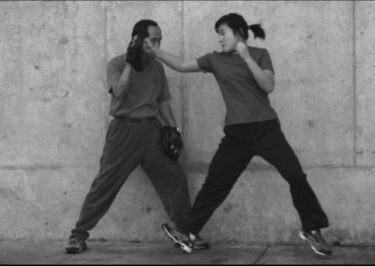
Teri Tom says:
“Without a technical core from which to draw, people have fixated on the philosophical principles of JKD. But merely spouting philosophy does not make someone a JKD practitioner.
We began our journey with some words from Takuan Soho (a Zen Poet/Master who strongly influenced the Samurai spirit), so it’s only fitting that we should end in the same way:
‘There is such a thing as training in principle, and such a thing as training in technique.
Principle is: when you arrive, nothing is noticed. It is simply as though you had discarded all concentration.
If you do not train in technique, but only fill your breast with principle, your body and your hands will not function. Training in technique, if put into terms of our own martial art, is in the training that if practiced over and over again makes the five body postures one.
Even though you know principle, you must make yourself perfectly free in the use of technique. And even though you may wield the sword that you carry with you well, if you are unclear on the deepest aspects of principle, you will likely fall short of proficiency.
Technique and principle are just like the two wheels of a cart.’
Bingo!
There’s no such thing as training only in principle. Physical training must be, well, you know…physical. I can’t stop a home intruder with a principle. On the contrary, I stop him with a technique trained in and through that principle. What we have here is what philosophy proper calls the “problem of the one and the many” or the unity-diversity paradox. Extremes on either side are to be avoided. The extreme of those who deride the straight hit method of JKD’s simplicity as taught by Teri Tom and detailed in her book commit the fallacy of divorcing ideas from action. They’re gnostics of martial arts. Even still, in the end the fallacy traps them into trying to apply “JKD ideas” like seasoning to other intact martial systems just as Ted Wong argued. This is why you see the JKD Concepts adherents always doing other systems like Kali, Muay Thai and so on.
To this end, Teri says in her book:
“For several decades now, people have been trying to roll their JKD cart with one wheel. It is beyond the scope of this book to address the philosophical side of JKD, and besides, it is more than adequately accounted for by John Little’s excellent cataloguing of Bruce Lee’s own words.
“What I’ve given you here is a part of the other wheel, if you will—the technical wheel. This documentation of the hows and whys of the straight lead is an attempt to recover some of what has been lost through misinterpretation, misrepresentation, and the ambition and personal advancement of certain individuals. As Ted Wong told Black Belt magazine, ‘You have to preserve [Bruce Lee’s] art at some point to prevent it from completely disappearing. Otherwise, he’s just a name; he died and he’s gone. So right or wrong, that’s my desire—to preserve Bruce Lee’s Jeet Kune Do. I’m [sharing my knowledge] to honor him.’”